Sustainable urban mobility in climate emergency adaptation
the contested public space
DOI:
https://doi.org/10.5935/cadernospos.v25n2p228-245Keywords:
Urban mobility, Climate crisis, Environmental justice, PetrópolisAbstract
The paper approaches the relationship between urban mobility, public space, and inequality in the climate emergency. Taking as a starting point the profound impact of Petrópolis’ socio-environmental tragedies caused by extreme rains in summer 2022, it investigates how space production has led to an increase in extreme climate events vulnerability, underlying why and how these episodes have unequally affected different places and social groups. It points to the influence of private motor vehicle-centered mobility in cities’ decision-making as an obstacle to the necessary changes. In opposition to this model, the study seeks to analyze the aspects that turn sustainable urban mobility into a powerful tool to reshape urban spaces and make cities environmentally safer and socially fairer.
Downloads
References
ACSELRAD, H.; MELLO, C.; BEZERRA, G. O que é justiça ambiental. Rio de Janeiro: Garamond, 2009.
ANDRÉS, R. A dupla exclusão: como a quarentena joga luz sobre as crises do clima e das cidades. Piauí, São Paulo, n. 165, jun. 2020. Disponível em: http://piaui.folha.uol.com.br/materia/a-dupla-exclusao/. Acesso em: 13 set. 2024.
BRASIL. Lei n. 601, de 18 de abril de 1850. Dispõe sobre as terras devolutas do Império. Rio de Janeiro: livro 1º de Actos Legislativos. 18 abr. 1850.
BRASIL. Censo 2022. Rio de Janeiro: IBGE, 2024. Disponível em: https://censo2022. ibge.gov.br/panorama/index.html. Acesso em: 24 fev. 2025.
C40 CITIES. Mobilidade sustentável para uma Buenos Aires neutra em carbono, resiliente e inclusiva. C40 Cities, ago. 2022. Disponível em: https://www.c40. org/pt/case-studies/sustainable-mobility-buenos-aires. Acesso em: 20 fev. 2025.
GONZÁLEZ, S. The cycling revolution in Paris continues: bicycle use now exceeds car use. El País, 24 abr. 2024. Disponível em: https://english.elpais.com/lifestyle/2024-04-24/the-cycling-revolution-in-paris-continues-bicycle-use-now-exceeds-car-use.html. Acesso em: 26 fev. 2025.
GREGORI, M. S. et al. SUM: a nova perspectiva para a mobilidade urbana. Le Monde Diplomatique Brasil, p. 5-6, fev. 2024.
IPCC - INTERGOVERNMENTAL PANEL ON CLIMATE CHANGE. Climate Change 2023: Synthesis Report. Contribution of Working Groups I, II and III to the Sixth Assessment Report of the Intergovernmental Panel on Climate Change. Core Writing Team, H. Lee e J. Romero (eds.). Genebra, Suíça: IPCC, 2023.
ITDP BRASIL. Boletim #1 Mobilidados: mobilidade de baixo carbono. Rio de Janeiro: ITDP Brasil, 2019.
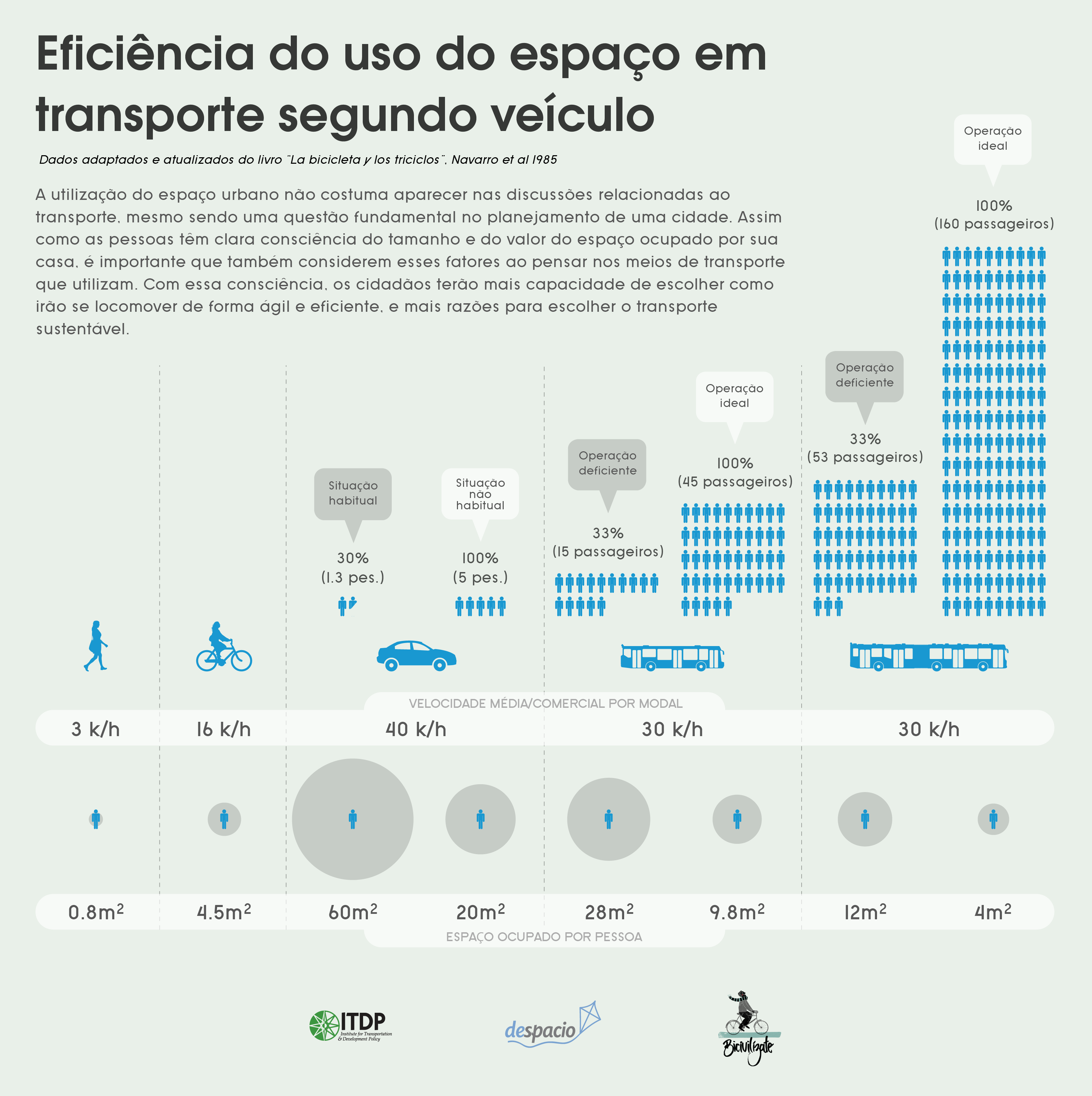
ITDP BRASIL. Eficiência no uso do espaço segundo veículo. 2015. 1 infográfico. Disponível em: https://itdpbrasil.org/wp-content/uploads/2015/03/uso-do-espaco.png. Acesso em: 8 nov. 2025.
ITDP BRASIL. Quais são os desafios de raça, renda e gênero na mobilidade? ITDP Brasil, 14 abr. 2021. Disponível em: http://itdpbrasil.org/quais-sao-os-desafios-de-genero-raca-e-renda-na-mobilidade/. Acesso em: 24 nov. 2024.
KARTHA, S. et al. The Carbon inequality era: an assessment of the global distribution of consumption emissions among individuals from 1990 to 2015 and beyond. Joint research report. Estocolmo: Stockholm Environment Institute; Oxfam International, 2020.
KLUMB, Revert Henrique. Rua D. Afonso (atual Av. Koeler). [ca. 1980]. 1 fotografia. Disponível em: https://brasilianafotografica.bn.gov.br/brasiliana/handle/20.500.12156.1/2404. Acesso em: 8 nov. 2025.
MACEDO, E.; SANDRE, L. H. Mortes por deslizamentos no Brasil: 1988 a 2022. Revista Brasileira de Geologia de Engenharia e Ambiental, v. 12, n. 1, p.110-117, 2022.
MARTINS, T.; BARCELLOS, F.; DRACH, P. Caminhos para além de Petrópolis: das estradas reais às rodovias. Periódico Técnico e Científico Cidades Verdes,
v. 10, n. 27, p. 143-160, 2022.
NEVES, F. Os piscinões de Koeler. Instituto Histórico de Petrópolis, 13 set. 2021. Disponível em: http://ihp.org.br/?p=7869. Acesso em: 15 maio 2023.
OKRA. A climate-adaptive backbone for the centre of Utrecht. OKRA, 2025. Disponível em: https://www.okra.nl/project/catharijnesingel/. Acesso em:
nov. 2025.
PAIVA, A. L. Todo poder às pessoas: a pedagogia urbana na recuperação de Petrópolis. Petrópolis, 2022. Trabalho de conclusão de curso (Graduação em Arquitetura e Urbanismo) – ESDI – UERJ.
PEREIRA, G. Posse de veículos por raça no Brasil. Journal of Sustainable Urban Mobility, v. 1, n. 2, mar. 2021. DOI http://doi.org/10.7910/DVN/JSR6PF.
PETRÓPOLIS (RJ). Plano Municipal de Redução de Risco PMRR: 1º (revisão), 2º, 3º, 4º e 5º distritos - Petrópolis, RJ. Petrópolis: Secretaria de Habitação, 2017.
PETRÓPOLIS (RJ). Plano de contingência 2021: inundações. Petrópolis: Secretaria de Defesa Civil e Ações Voluntárias, 2020.
PETRÓPOLIS (RJ). Transparência Emergencial. Petrópolis, [atualizado em] 15 ago. 2022. Disponível em: https://web2.petropolis.rj.gov.br/gap/transparencia-emergencial/. Acesso em: 7 set. 2022.
REIS, J. G. M. Impacto da ciclomobilidade na redução de emissões de poluentes na cidade de São Paulo. In: ENCONTRO NACIONAL DE ENGENHARIA DE PRODUÇÃO, 44., 2024, Porto Alegre. Anais [...]. Porto Alegre: Enegep, 2024.
RIBEIRO, N.; AMORIM, R.; ABAD, V. Breve histórico sobre a colonização germânica em Petrópolis. Petrópolis, [s. d.]. Disponível em: http://web2.petropolis.rj.gov.br/bauern/paginas/historia. Acesso em: 13 out. 2024.
RIO DE JANEIRO [estado]. Portal da transparência: obras. Rio de Janeiro, [atualizado em] 5 set. 2022. Disponível em: https://www.rj.gov.br/transparencia/obras. Acesso em: 7 set. 2022.
SANTOS, K.; ANTUNES, F.; FERNANDES, M. Os rios, a cidade e o mapa como objeto de análise da dinâmica da paisagem. Mercator, v. 18, 2019.
SCHVARSBERG, G.; PAIVA, A.; ROCHA, E. Mobilidades pós-antropocênicas: o potencial político de especulações projetuais em paisagens carrocêntricas. Revista de Morfologia Urbana, v. 12, n. 2, 2025. DOI https://doi.org/10.47235/rmu.v12i2.427.
THUNBERG, G. (org.). El libro del clima. Barcelona: Lumen, 2023.
UNFCCC - UNITED NATIONS FRAMEWORK CONVENTION ON CLIMATE CHANGE. Paris Agreement. 21st Conference of the Parties. Paris: UNFCCC, 2015.

Downloads
Published
How to Cite
Issue
Section
License
Copyright (c) 2025 Gabriel Schvarsberg, André Luís Paiva Gonçalves de Oliveira e Silva, Emanuela Alves da Rocha

This work is licensed under a Creative Commons Attribution 4.0 International License.
Authors who publish in this journal agree to the following terms:
a) Authors retain the copyright and grant the journal the right of first publication, with the Project simultaneously licensed under the Creative Commons Attribution License that allows the sharing of the Project with recognition of the authorship and initial publication in this journal.
b) Authors are authorized to assume additional contracts separately for the non-exclusive distribution of the version of the Project published in this journal (e.g., publishing in an institutional repository or as a book chapter), indicating that it was originally published in this journal, with a link to the article.






 Todo o conteúdo de Cadernos de Pós-Graduação em Arquitetura e Urbanismo está licenciado sob